What Is Ghee? How It's Made, What It Tastes Like, and How to Use It
Ghee is pure milk fat. It is made by slowly heating butter (makkhan) until all the water cooks off and the milk solids turn golden, then straining the clear fat away from them. What is left is almost 100% fat, with a nutty, roasted aroma that butter does not have. It keeps for months without a fridge and is the everyday cooking and finishing fat of South Asian kitchens.
- 1ingredient: milk fat
- 99.5%+milk fat in graded ghee
- Monthsin the cupboard, no fridge needed
- High heatno milk solids left to burn
What ghee is made of
Real ghee has one ingredient: milk fat. In India, the food regulator FSSAI defines ghee as pure heat-clarified fat made only from milk, curd or butter, with no colour or preservative added. Graded ghee must be at least 99.5% milk fat with no more than 0.5% moisture.
That is the whole point of ghee. Butter is roughly four-fifths fat, with the rest mostly water plus a little milk protein and milk sugar. Cooking butter into ghee drives off the water and leaves the protein and sugar behind as browned bits at the bottom of the pan. Those browned bits are where much of ghee's flavour comes from, and removing them is why ghee keeps so much longer than butter.
Reading a label: on a jar of ghee, look for one ingredient, such as "butter", "milk fat" or "makkhan". Anything extra, such as vegetable oil, "flavour" or colour, means it is no longer plain ghee.
How ghee is made
Every method ends the same way: butterfat is heated until the water is gone and then strained. Where methods differ is how they get to the butter, and that changes the flavour.
Desi, from dahi
- Milk
- Boil, then cool
- Set into dahi
- Churn
- Makkhan (desi butter)
- Slow-cook
- Ghee
Desi, from malai Our way
- Milk
- Simmer, then cool
- Skim off the malai
- Culture with dahi, churn
- Makkhan (desi butter)
- Slow-cook
- Ghee
Factory, direct
- Milk
- Machine separator
- Separated milk fat, fresh or ripened
- Heat directly
- Ghee
Factory, via butter
- Milk
- Machine separator
- Separated milk fat, ripened or aged
- Churn
- Factory butter
- Heat: direct boiling, pre-stratification or a continuous heat exchanger
- Ghee
Based on the standard ghee-making routes taught in Indian dairy technology (see NIFTEM in the sources).
The traditional desi way, starting from malai
- Collect the malai. Fresh milk is simmered and left to cool. A thick layer of malai forms on top and is skimmed off, day after day, until there is enough.
- Culture it. A spoon of the previous day's dahi (curd) or buttermilk is stirred in and the malai is left to sour slightly. This step builds the deeper, slightly tangy aroma of home-made ghee.
- Churn it into makkhan. The cultured malai is churned until butter grains separate from the buttermilk.
- Slow-cook the makkhan. The butter is heated gently. It foams, then the bubbling quietens as the water leaves, and the milk solids settle and turn golden brown.
- Strain and fill. The clear golden fat is strained off the residue (in many homes the toasted residue is eaten with sugar) and poured into clean, dry jars.
Indian dairy teaching material from NIFTEM notes that this indigenous method still makes most of India's ghee, although it recovers less fat than factory methods, so it costs more per kilo to produce.
Faster factory routes
Large dairies often skip culturing. They separate the milk fat by machine and heat it directly (the direct method), or churn it into factory butter and cook that down by direct boiling, by letting the melted butter settle first (pre-stratification), or in a continuous heat exchanger, typically finishing at around 107 to 110°C before clarifying. These methods are efficient and perfectly safe. The ghee is usually milder and more neutral, because there was no culturing step and less time for flavour to develop. Not every brand works the same way, so if the method matters to you, ask the maker.
What ghee tastes, looks and feels like
Taste and aroma. Good ghee smells nutty and toasty, a little like caramel, with a rich, rounded taste. Ghee from cultured makkhan has an extra depth that many people call the "home-made" smell. Ghee cooked hotter or longer tastes more roasted; ghee taken off the heat early tastes lighter.
Colour. Cow ghee is golden yellow because cows pass carotene from grass and fodder into their milk fat. Buffalo ghee is white to off-white, sometimes with a slight greenish tint, because buffalo milk fat carries almost no carotene. Colour tells you which milk was used, not how good the ghee is.
Texture. Ghee melts to a clear liquid when warm and sets when cool. Left to cool slowly, it forms a grainy, sandy texture that Indian buyers call danedar. Grading standards even look for well-defined granules. Graininess depends a lot on how the ghee was cooled and stored, though, so it is a good sign but not proof of purity on its own.
Cow ghee vs buffalo ghee
Both are real ghee, made the same way. The difference is the milk.
| Cow ghee | Buffalo ghee | |
|---|---|---|
| Colour | Golden yellow | White to off-white |
| Milk fat | Cow milk has less fat | Buffalo milk is much richer in fat, so each litre yields more ghee |
| Flavour | Lighter and sweeter | Fuller and richer |
| Texture | Smooth to lightly grainy | Often more noticeably grainy (danedar) |
| Popular for | Everyday cooking, rotis, infants and elders in many homes | Biryani, halwa, sweets, Hyderabadi and Punjabi cooking, finishing dishes |
Neither is universally healthier or better. It comes down to the flavour you want and how the ghee was made.
Ghee vs butter vs cooking oil
| Ghee | Butter | Vegetable oil | |
|---|---|---|---|
| What it is | Pure milk fat, water and milk solids removed | About 80% milk fat, the rest mostly water and milk solids | Fat pressed or extracted from seeds |
| Flavour | Nutty, roasted | Fresh, milky | Neutral to grassy, depending on the oil |
| High-heat cooking | Good. No milk solids left to burn | Burns quickly. The milk solids brown and blacken | Depends on the oil |
| At room temperature | Semi-solid; keeps for months in a sealed jar | Solid; best kept in the fridge | Liquid; keeps for months |
| Dairy | Yes, from milk. Very little lactose | Yes. Contains lactose and milk protein | No |
You can usually swap ghee for butter or oil one for one in savoury cooking. For baking, remember that butter brings water and ghee does not, so cakes and cookies made with ghee can turn out a little denser or crisper. Start by using slightly less ghee than the butter in the recipe.
How to use ghee
Think of ghee in two ways: as a cooking fat, and as a finishing touch added at the end for aroma.
Cooking with ghee
- Tadka (tempering). Heat a spoon of ghee, add cumin, mustard seeds, garlic or dried chillies, and pour it sizzling over dal.
- Frying onions and spices for biryani, korma and curries. Ghee carries the spice flavour well and does not burn as easily as butter.
- Roasting. Sooji for halwa, besan for laddoos, vermicelli for sheer khurma.
- Everyday pans. Eggs, parathas, dosas and roasted vegetables.
Finishing with ghee
- A spoon over hot dal and rice, the classic "dal chawal with ghee".
- Brushed on fresh rotis and phulkas.
- Drizzled warm over the rice layers of a biryani before it goes on dum.
- Stirred into haleem, khichdi or sweets at the end, when the aroma is strongest.
Aroma fades with long cooking, so if you want people to smell the ghee, add some at the end.
How to store ghee
- Keep the jar tightly closed in a cool, dry place, away from sunlight and the stove. A fridge is optional.
- Always use a clean, dry spoon. Water or food crumbs in the jar are what usually spoil ghee.
- Ghee going solid in winter and liquid in summer is normal and does not change the taste.
- If it smells sour, soapy, stale or like old paint, it has gone rancid. Throw it away.
Ghee keeps far longer than butter because there is almost no water left in it. We ask everyone to keep HYDERABADI ghee away from direct sunlight. Stored that way, with the lid closed and a dry spoon, it stays good for a very long time.
Is ghee healthy?
Here is the plain answer. Ghee is a concentrated fat. One tablespoon (13 g) has about 117 calories and roughly 10 g of saturated fat, according to the nutrition panel on our own jar. The World Health Organization recommends keeping saturated fat under 10% of your daily calories, so ghee is best enjoyed as part of a balanced diet, not by the bowl.
What ghee does offer is a lot of flavour from a small amount, so a little goes a long way. It also contains very little lactose, which is why many people who struggle with milk find ghee easier. Ghee is still a dairy product, though, and can carry traces of milk protein. If you have a milk allergy, do not treat ghee as safe unless your doctor says so.
You will find plenty of big health claims about ghee online. We would rather not repeat claims we cannot back up. If you have a medical condition, ask your doctor or a dietitian how much fat is right for you.
Quick questions
Is ghee the same as clarified butter?
Nearly. Both are butter with the water and milk solids removed. Ghee is cooked longer, until the milk solids brown, which gives it a nutty flavour. Western clarified butter is usually taken off the heat before the solids colour, so it tastes plainer.
Does ghee need to be refrigerated?
No. A sealed jar of ghee keeps well in a cool, dry cupboard. A fridge can stretch its life further, but use a dry spoon either way.
Why is my ghee grainy?
Graininess forms as the fat cools and crystallises slowly. It is normal, and many people prefer it. Gently warming the jar turns it clear and liquid again.
Why is buffalo ghee white?
Buffalo milk fat carries almost no carotene, the natural pigment that makes cow ghee yellow. White ghee is normal for buffalo milk.
Is ghee vegetarian?
Yes. Ghee is made from milk, so it is vegetarian. It is not vegan.
Why we think HYDERABADI ghee is usually the better choice
Everything above is true of good ghee anywhere. Here is what we do, so you can judge for yourself.
- Buffalo milk from Hyderabad. Our milk comes from buffalo herds on the edge of Hyderabad, the city our ghee is named after, and is chilled within hours.
- Malai, made the old way. The milk is simmered and cooled, and the layer of malai is skimmed off and collected, just as it is at home.
- Cultured, then churned. The malai is set with dahi and churned into makkhan. This is the step many large producers skip, and it is where our aroma comes from.
- Slow-cooked, one ingredient. The makkhan is cooked over a low flame until the residue turns golden. Ingredients: butter (makkhan). Nothing added.
- Exceptional smoke point. It says so on our jar, and it's why our ghee is made for tadka, frying and biryani as much as for a spoon over dal.
- Registered and checked. FSSAI licensed, with our ISO 9001 and HACCP certifications printed on the jar alongside every registration, all listed on our product sheet.
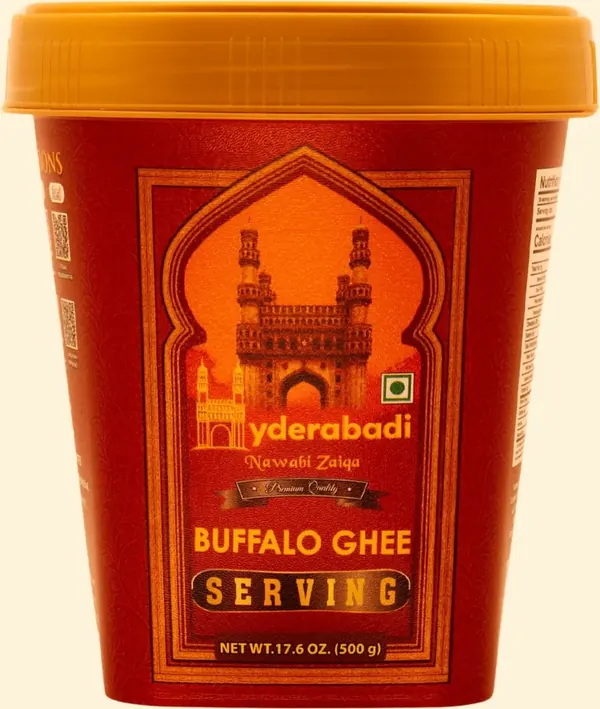
When another ghee might suit you better: if you prefer a light, golden cow ghee for everyday cooking, buffalo ghee will taste richer than you are used to. For biryani, halwa, sweets and a spoon over dal chawal, that richness is exactly the point.
Try cooking with it
Make tonight's dal, rice or rotis with a spoon of HYDERABADI ghee and taste the difference. 500 g jar, 38 servings.
Sources
- FSSAI, Food Safety and Standards (Food Products Standards and Food Additives) Regulations, 2011: definition of ghee, as summarised in NIFTEM, Ghee Processing (PMFME training material). Also the source for production methods, cooking temperatures and keeping quality.
- Warehousing Development and Regulatory Authority (Government of India), Ghee: milk fat and moisture limits, colour and granular texture in grading.
- Tetra Pak Dairy Processing Handbook, Anhydrous milk fat and butteroil: Codex composition of ghee and other milk fat products.
- USDA FoodData Central: composition of butter.
- World Health Organization, Healthy diet fact sheet: saturated fat guidance.
- HYDERABADI 500 g jar label: nutrition panel, ingredients and storage.